CBM stands for Cubic Meter (m³), the international metric unit used in logistics to measure the physical volume of cargo. In freight forwarding, CBM is calculated by multiplying Length × Width × Height (in meters). Carriers across ocean, air, and road freight compare total CBM against gross weight to establish Volumetric Weight and determine the final Chargeable Weight for transport billing.
Mục lục▼
Understanding CBM: Definition, Mathematical Equivalents, and Core Purpose
What Does CBM Stand For in Logistics?
CBM is an acronym for Cubic Meter (or mét khối in Vietnamese metric notation). It represents a three-dimensional cube with dimensions measuring exactly one meter in length, one meter in width, and one meter in height (1 m × 1 m × 1 m).
Whether shipping small cartons by air express or consolidating industrial machinery into ocean containers, CBM serves as the universal benchmark for spatial planning, warehouse storage tariffs, container stuffing optimization, and freight rate quotation.
Standard Mathematical Equivalents of 1 CBM
To facilitate seamless cross-border calculations between the Metric system and Imperial system, 1 CBM equals:
1 m³ (Cubic Meter)
1,000,000 cm³ (Cubic Centimeters)
1,000 Liters (Fluid Volume Equivalent)
35.315 cu ft (Cubic Feet / CFT)
61,024 cu in (Cubic Inches)
How to Calculate CBM: Universal Formulas by Measurement Unit
Calculating the volume of your shipment is straightforward once all package dimensions are recorded in identical units:
1. Calculating CBM Using Meters (m)
When cargo measurements are taken directly in meters:
Total CBM = Length (m) × Width (m) × Height (m) × Total Quantity of Packages
Example: A shipment consists of 10 cartons, each measuring 1.2 m long, 0.8 m wide, and 0.5 m high.
Total CBM = 1.2 × 0.8 × 0.5 × 10 = 4.8 CBM
2. Calculating CBM Using Centimeters (cm)
Because standard commercial packaging is typically measured in centimeters, divide the cubic centimeter product by 1,000,000 to convert the measurement to cubic meters (CBM).
Total CBM = (Length (cm) × Width (cm) × Height (cm) ÷ 1,000,000) × Total Quantity
Example: A shipment consists of 50 boxes measuring 60 cm × 40 cm × 30 cm.
Total CBM = (60 × 40 × 30 ÷ 1,000,000) × 50
Total CBM = 0.072 × 50 = 3.6 CBM
3. Calculating CBM Using Inches (in)
For shipments originating in or destined for the United States where dimensions are noted in inches:
Total CBM = (Length (in) × Width (in) × Height (in) ÷ 61,024) × Total Quantity
Example: 20 cartons measuring 24 in × 16 in × 12 in.
The Golden Rule: Volumetric Weight vs. Chargeable Weight Across Transport Modes
Transport vehicles (aircraft cargo holds, container vessels, freight trucks) have strict dual limitations: Volume Capacity (how much physical space is available) and Weight Capacity (how much mass the vehicle can legally and safely carry).
To ensure fair freight pricing, carriers compare the Actual Gross Weight (the scale weight in kg) against the Volumetric Weight (the dimensional density converted to kg). Freight is always invoiced on whichever number is higher—known as the Chargeable Weight (Trọng lượng tính cước).
1. Sea Freight (Ocean LCL / Less than Container Load)
In ocean groupage shipping, the standard maritime ratio is:
1 CBM = 1,000 kg = 1 Metric Ton (1 Revenue Ton / RT)
Heavy / Deadweight Cargo (Hàng nặng): If 1 CBM weighs more than 1,000 kg, billing is charged per Metric Ton.
Light / Volumetric Cargo (Hàng cồng kềnh / Hàng nhẹ): If 1 CBM weighs less than 1,000 kg, billing is charged per CBM.
2. Standard Air Freight (IATA Commercial Cargo)
Commercial airlines apply the international ICAO/IATA standard volumetric ratio of 1 CBM = 167 kg (Standard Divisor: 6,000).
Express air couriers operate with faster turnaround and smaller regional aircraft, applying a higher dimensional density ratio of 1 CBM = 200 kg (Express Divisor: 5,000).
Alternative calculation: 2.4 CBM × 166.67 = 400 kg
Comparison: 400 kg (Volumetric) > 200 kg (Actual)
Billing Outcome: The airline invoices the shipment based on 400 kg Chargeable Weight.
Standard Ocean Container CBM Capacity and Usable Payloads
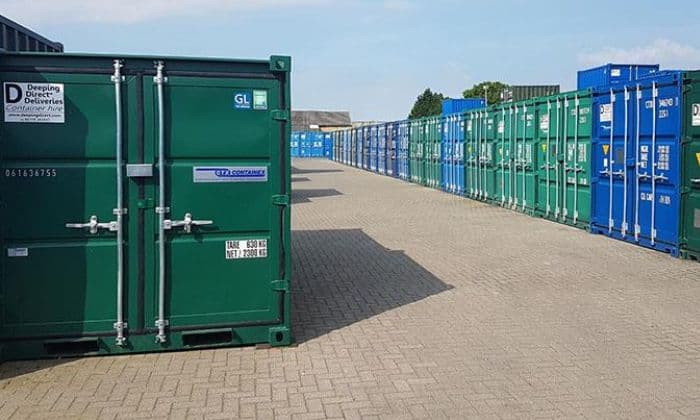
When planning full container load (FCL) shipments, shippers must distinguish between the container’s Theoretical Maximum Internal Volume and its Practical Usable Payload Volume (accounting for carton stacking clearances, internal door locks, and pallet overhead):
Container Type
Maximum Theoretical Volume
Realistic Usable Payload (CBM)
Recommended Use Case
20ft Standard GP
~33.2 CBM
28 – 30 CBM
Dense, heavy industrial cargo (metals, machinery, stone, minerals)
40ft Standard GP
~67.7 CBM
58 – 60 CBM
Standard general cargo, textiles, consumer electronics, packaged food
When cargo is loaded onto wooden or plastic pallets for mechanized forklift handling, the pallet itself contributes to the total billable volume:
Standard Pallet Dimensions in Global Logistics
Standard Euro Pallet (EUR 1): 1,200 mm × 800 mm × 144 mm (47.2 in × 31.5 in × 5.7 in)
Standard US Industrial Pallet (GMA): 1,200 mm × 1,000 mm × 150 mm (48 in × 40 in × 6 in)
Best Practices to Minimize Palletized Volume Overhead
Measure from the Floor: Always calculate total height starting from the bottom of the pallet base to the highest point of the stacked cartons.
Prevent Overhang and Chimney Stacking: Cartons protruding past the pallet edges force carriers to calculate dimensions based on the widest protruding edge, drastically inflating billable CBM.
Account for the 10–15% Broken Space Factor: When loading loose cartons into a container, irregular shapes create unoccupied gaps (Broken Space). Multiplying total container capacity by 0.85 provides an accurate estimate of actual carton intake.
Frequently Asked Questions (FAQ) About CBM in Logistics
How many kilograms is 1 CBM?
In ocean freight (LCL), 1 CBM equals 1,000 kg (1 Metric Ton). In standard air freight, 1 CBM equals 167 kg. In express courier shipping (DHL/FedEx/UPS), 1 CBM equals 200 kg. In overland road trucking, 1 CBM equals 333 kg.
How do I convert CBM to CFT (Cubic Feet)?
To convert CBM to Cubic Feet (CFT), multiply the CBM value by 35.315. CFT = CBM × 35.315 Example: 5 CBM × 35.315 = 176.575 CFT Conversely, to convert CFT to CBM, divide the CFT value by 35.315. CBM = CFT ÷ 35.315
How many CBM fit into a 20-foot container?
While a 20ft container has a total internal volume of approximately 33.2 CBM, practical stuffing constraints typically allow between 28 and 30 CBM of usable cargo space for loose cartons, or 22 to 24 CBM if goods are palletized.
What is the difference between Gross Weight and Chargeable Weight?
Gross Weight is the actual physical weight of the cargo including product packaging, cartons, and pallets as measured on a weighing scale. Chargeable Weight is the higher value between the Actual Gross Weight and the Dimensional/Volumetric Weight, representing the final billable weight used by carriers.
Why did my freight forwarder charge by volume instead of actual weight?
If your shipment consists of lightweight, bulky items (such as clothing, plastic bottles, footwear, or plush toys), the space your shipment occupies in the cargo hold costs the carrier more than its physical weight. Consequently, carriers apply volumetric weight formulas to charge based on space consumption.
Conclusion: Master CBM Calculations to Optimize Freight Budgets
Understanding how to calculate CBM and navigate the relationship between volume, gross weight, and chargeable weight is vital for optimizing international supply chains. Accurate CBM calculations empower businesses to forecast freight expenditures, select optimal container sizes, and eliminate unexpected shipping surcharges.
Was this article helpful to you?
5.0 / 5 (2 lượt đánh giá)
8/27/2026
Incoterms 2020 Explained: The Complete Guide to the 11 ICC Rules, Key Changes, and Global Shipping Compliance